
If you are researching how to track your shipment, this guide is written for you. We move cars internationally every day from UK ports, and this page is the same briefing we give first-time customers when they ask about this topic. It is practical, current for 2026, and free of marketing fluff — read it end to end and you will understand the process well enough to make a confident booking decision. We have deliberately kept the structure simple: the basics, how it actually works, what it costs, the mistakes to avoid, the paperwork, and how to translate that knowledge into a clean booking.
The basics
How to Track Your Shipment sits inside the wider world of international vehicle logistics. To understand it properly you need to know the difference between RoRo and container shipping, how UK export paperwork works through DVLA, and how destination customs assess duty and VAT. We will summarise each of these as we go, but the headline is: car shipping is a regulated, document-driven business and the quality of your shipper matters more than the headline price.
The UK is one of the most active vehicle export markets in the world. Right-hand drive cars from Britain are in demand across Africa, the Middle East, Asia, Oceania and the Caribbean, and left-hand drive classics and prestige cars move regularly into Europe and the Americas. Whatever your route, the same core principles apply. The dominant carriers on the major outbound lanes are Wallenius Wilhelmsen, Grimaldi, Hoegh Autoliners, NYK and K-Line, and almost every reputable UK forwarder books onto the same vessels.
How the process actually works
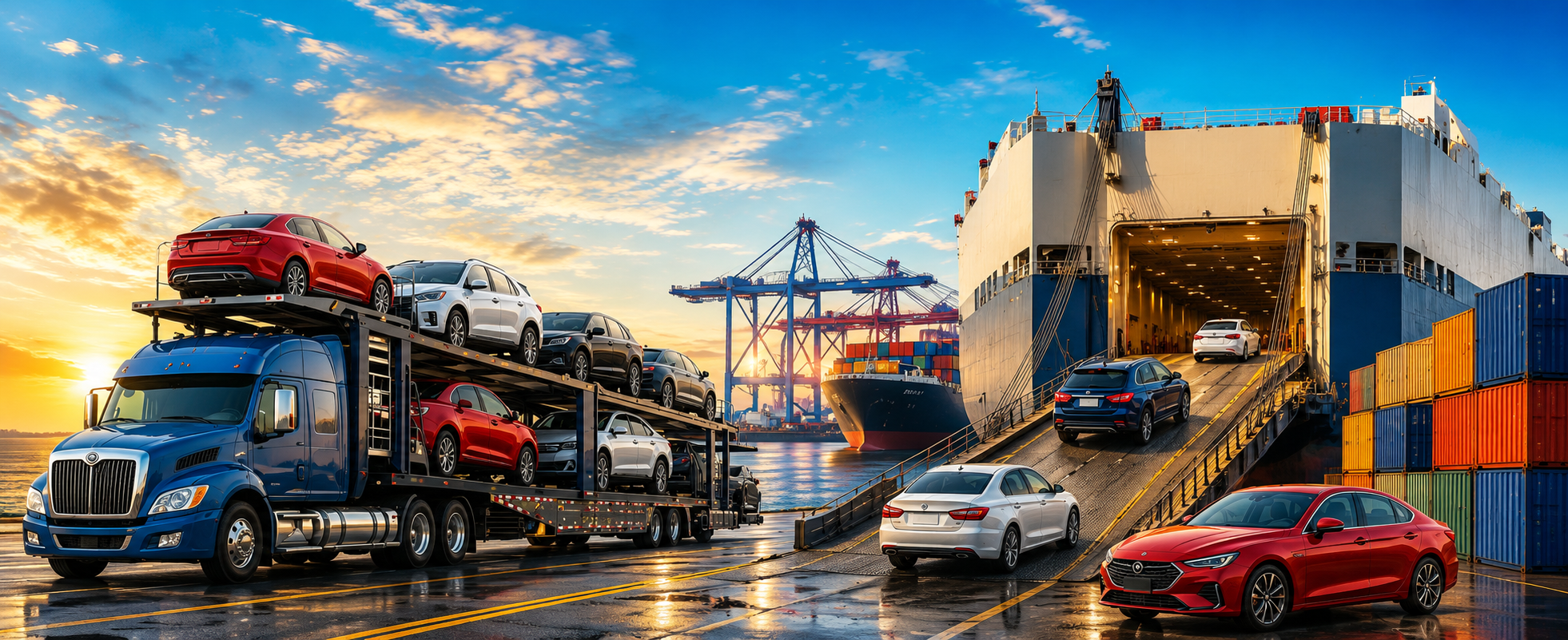
A typical international car shipment runs through six clean stages: quote, booking and deposit, UK collection, port loading, ocean voyage, and destination clearance. The customer-facing parts are the first two and the last one — everything in the middle is handled by the freight forwarder, the port, the shipping line and the customs broker.
Get the first stage right and the rest tends to follow. That means a written, fixed-price quote that lists every cost line, names the carrier, gives you a realistic sailing date, and includes Marine Insurance as an option. Verbal quotes and "estimates that may change" are red flags and the source of almost every horror story you read online.
- Stage 1: Request a written quote with all costs listed
- Stage 2: Pay deposit and submit original V5C logbook
- Stage 3: UK collection or self-deliver to the port
- Stage 4: Loading window and vessel cut-off
- Stage 5: Sea transit (RoRo or container)
- Stage 6: Destination customs clearance and collection
What it costs in 2026
Pricing depends on the destination, the vehicle, the method (RoRo vs container) and the time of year. As a 2026 benchmark, a standard family-sized car shipped RoRo from the UK to a major overseas port lands between £950 and £1,800 all-in to the destination port. Containers cost more but unlock options that RoRo cannot offer.
Beware of any quote that looks dramatically cheaper than the rest of the market. The cost of a vessel slot is broadly the same for every reputable forwarder, so a heavily discounted headline number almost always means a hidden cost will appear later — typically destination handling, BAF, or documentation fees that were not disclosed up front. A genuine fixed-price quote will spell out every line; if a quote you are reading does not, ask the question in writing before you pay a deposit.
Common mistakes to avoid
The mistakes we see most often are surprisingly consistent. They cost time, money and in the worst cases cost the customer their vehicle. Every one of them is avoidable with five minutes of due diligence at the quote stage.
- Booking with a forwarder who is not a member of BIFA
- Paying a large deposit before the original V5C is processed
- Skipping Marine Insurance to save a small premium
- Leaving personal items in the car on a RoRo sailing
- Assuming the destination will accept the vehicle without checking age and emissions rules
- Not appointing a local clearing agent before the vessel arrives
- Accepting a quote that does not name the carrier or the sailing date
Paperwork and compliance
UK vehicle exports are governed by HMRC and DVLA. You must notify DVLA of permanent export (V5C/4 section), and the vehicle must be tax and MOT clear at the point of export. We handle the customs export entry on your behalf and issue a Bill of Lading once the vessel sails — that document is what unlocks the car at the destination port.
Destination paperwork varies by country. Some markets require a Certificate of Conformity, some require pre-shipment inspection, and some impose age limits that block older vehicles entirely. Always confirm import eligibility before you book the sailing — we will not let a customer ship a vehicle that cannot legally be cleared at the other end. If the destination is unfamiliar we will quote a country brief alongside the freight quote so you understand the full landed cost.
Choosing between RoRo and container
This is the single most consequential decision you will make at quote stage. RoRo is faster, cheaper and simpler — but it only works for running, road-legal vehicles with no loose contents. Container shipping is slower and more expensive, but it accepts non-runners, low-slung classics, modified vehicles, and personal effects packed alongside the car.
As a rule of thumb: standard saloons, SUVs and pickups go RoRo unless the receiver specifically asks for a container. Classics, prestige and salvage vehicles go container. Anything travelling with parts, tools or household goods goes container. If you are unsure, send us a photograph of the vehicle and a description of what you would like to ship with it and we will recommend the right method.
Working out the total landed cost
The freight quote is only half of the equation. The total landed cost of a vehicle is the freight quote plus destination port handling, destination customs duty, destination VAT or sales tax, any inland transport, and your clearing agent's fee. On most lanes the destination charges are equivalent to 20–80% of the vehicle's CIF value — sometimes more in markets with high import protectionism.
Before you commit to a shipment, ask your forwarder for an estimated landed cost in the destination country. A reputable forwarder will be able to give you a tight range based on the declared value. If they cannot or will not, treat it as a warning sign.
Why this matters for your booking
Understanding how to track your shipment is not a theoretical exercise. The choices you make at the quote stage — RoRo vs container, named carrier, insured value, destination port — determine the timeline, the total cost, and the risk profile of the entire shipment. If you would like a no-obligation written quote with every cost line itemised, request one from our team and we will come back within one working day.
FAQ
Common questions
Q. Is this guide UK-specific?
Yes — written by the UK operations team at TheShipCars. The principles apply globally but examples assume UK origin.
Q. How current is the information?
Reviewed for 2026 sailings, pricing and regulations. We update guides when carriers, rules or rates change materially.
Q. Can I get a quote based on this guide?
Yes. Send us the vehicle and destination and we will reply within one working day with a fixed written quote.
Q. Do you ship into every country mentioned in your guides?
We ship into every major commercial port worldwide. If a destination is unusual we will tell you up front whether it is viable.
Ready to ship?
Fixed written quote within one working day.
Get Your QuoteMore from theshipcars.co.uk
Continue your research
- ↗Get a Free Shipping Quote
- ↗Car Shipping Cost Calculator
- ↗Car Shipping Costs 2026
- ↗Live RoRo Sailing Schedule
- ↗All Services
- ↗International Ports
- ↗All Destinations
- ↗UK Export Guide
- ↗Documents Required
- ↗Contact The Ship Cars
Opens on our main site, theshipcars.co.uk.